
04New Construction
Duct leakage testing for new construction
A duct leakage test measures how much air escapes from heating and cooling ducts. A tester seals the vents, attaches a fan and pressurizes the ducts. Builders test at rough-in, before walls close, and again at the end. ARUS is adding duct leakage testing for builders and getting the certifications now. Tell us about your project and we will tell you where we are.
01What it is
Why ducts leak and why it matters
Ducts carry heated or cooled air to each room. Every seam is a place for air to escape. A leaky duct in an attic or crawl space wastes energy and leaves rooms too hot or too cold.
A duct leakage test uses a calibrated fan, often called a duct blaster. The fan pushes air into the duct system and a gauge shows how much is leaking.
The test result is in cubic feet per minute, or CFM. The pressure matters. A test at 25 pascals gives a result called CFM25.
02Two kinds of result
Total leakage and leakage to outside
- 01
Total leakage
All the air that escapes the ducts, including air that leaks into spaces inside the home. This test can be done before the walls are closed.
- 02
Leakage to outside
Only air that escapes to outdoors, such as an attic or vented crawl space. It needs the house sealed up and a blower door running at the same time.
- 03
Which one applies to you
Your jurisdiction and code path decide which one counts and what the limit is.
- 04
A note on limits
We do not list a number here because it changes with the code path and local changes. Ask your building department, or ask us.
03When to test
Rough-in test and final test
Rough-in test
Done when the ducts are installed and visible, before drywall. Leaks are easy to seal with mastic then. A rough-in test can be done before the equipment is installed.
Seal and recheck
The HVAC crew seals seams and connections. The tester runs the fan again to confirm.
Final test
Done when the system is complete, if your code path calls for it. It checks the finished system.
Report
The tester gives you the numbers and a pass or fail.
What you receive
- The measured leakage, in CFM and in your code's units
- Pass or fail
- Notes on which seams to seal if it fails
04How to pass
How to pass a duct leakage test
Use mastic, a paste you brush on, at every seam and connection. Tape alone peels off over time. Seal the boots where ducts meet the floor or ceiling. Check the plenum and the connection to the furnace.
Keep ducts inside the heated space when you can. Short, straight runs leak less than long, twisted ones.
Have someone look at the system at rough-in. A fan test before the walls close is the cheapest way to avoid a retest. You can talk to us about your project now.
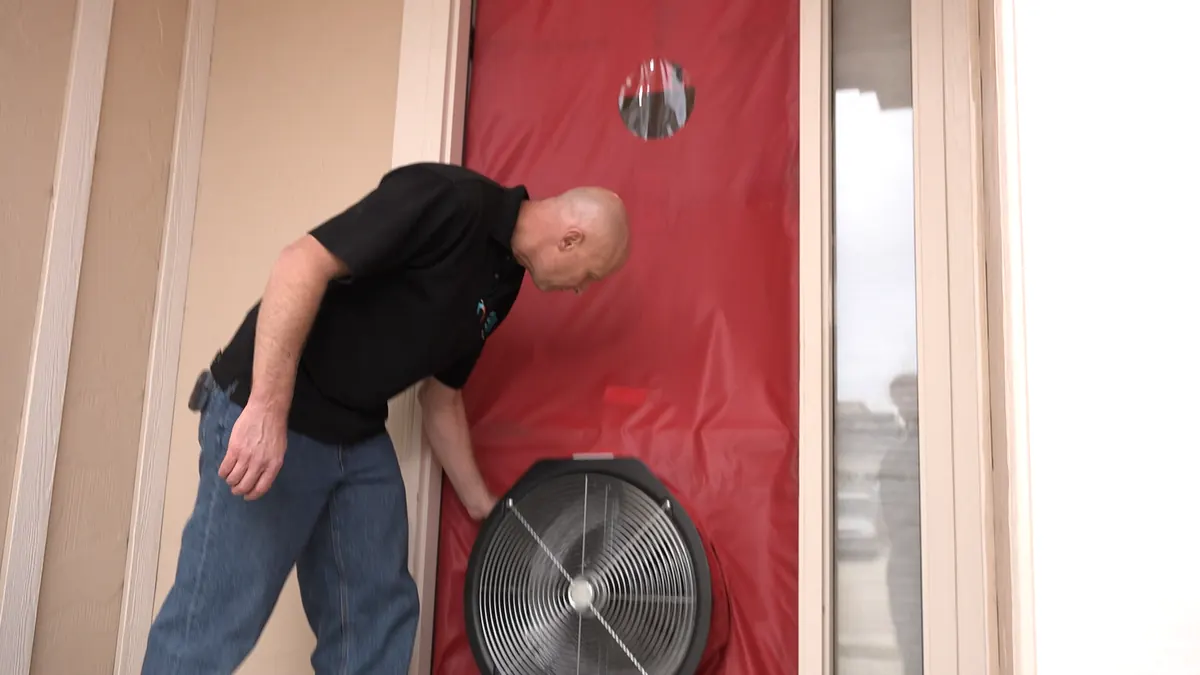
In the field
A fan in the doorway measures how leaky the building is.
A blower door fan mounted in a red panel in a doorway.
05Who it is for
Who needs duct leakage testing
Who it is for
- Builders and general contractors
- HVAC contractors who install and seal the ducts
- Developers with many homes on one permit
When you need it
- At rough-in, before drywall
- At the end, when the code path requires it
- Before you open walls to fix a leak
What is duct leakage testing?
It is a test that measures how much air leaks from a home's heating and cooling ducts. A fan pressurizes the ducts and a gauge shows the leak rate in CFM.
When is duct leakage testing required?
It depends on your jurisdiction and code path. Many builders test at rough-in and again at the end. Ask your building department which applies.
What are the duct leakage test requirements?
The code sets a maximum leakage and says when to test and how. Limits vary by local changes and by the test type.
How much does a duct leakage test cost?
Price depends on the number of systems and the stage. ARUS does not offer duct tests yet, so we have no price to quote.
How do I pass a duct leakage test?
Seal every seam and connection with mastic, not tape. Seal the boots. Test at rough-in so you can fix leaks while ducts are open.
What is the difference between total duct leakage and leakage to outside?
Total leakage counts all air that escapes the ducts. Leakage to outside counts only air that escapes to the outdoors. The second needs the home sealed with a blower door running.
What is CFM25?
It is the duct leakage in cubic feet per minute when the ducts are held at 25 pascals of pressure. Codes use CFM25 so every test is compared at the same pressure.
Who does duct leakage tests?
Raters, energy auditors and some HVAC contractors do. Your jurisdiction may limit who may test. ARUS is adding this service and getting its certifications now.
07Keep going
Related services
More from New Construction
The same service, other buildings
Get a quote for your project
Tell us the jurisdiction, the stage and how many homes or units.
Monday to Friday, 8:00am to 5:00pm. Based in Fort Collins, Colorado.